The Bentley 1/43 continental DHC from Yat Ming Models, Review.

The prototype

The Bentley Continental S2 was produced from 1959 onwards. It featured a new L series V-8 engine. Air conditioning and power steering made this a high end car with a high end price. Mint versions sell for close a quarter of a million pounds, today.

The Continental range was renowned for its Light weight chassis and powerful engines. Body styles included the two door convertible, as depicted by the Yat Ming models vehicle.

The model

Presentation.

The box makes this look like a high end model which it is not. Full marks for this, however.

Once the card cover is removed more delights await. The name of the vehicle is printed onto the base and there is a badge on top of the box. The model could be displayed on a desk without attracting dust.

The body shape is nicely represented and there is a minuscule mascot moulded into the radiator. The lighting cluster is well presented and the chrome work does not seem overdone. The metallic silver paint is well applied and does not have over-scale particles.

The red interior looks a bit plastic and there is a lack of detail on the dashboard. Unfortunate for a model where the interior is so visible. The windscreen wipers are separately fitted.

The rear aspect shows the Bentley badge and the folded down roof which is not painted.

The rearview mirror is part of the windscreen moulding.

Overall this is a great value model at only £14.99

Hornby Brush Type 4, Class 47, R.060 – Retro Review.

Is this the worst class 47 model ever produced? The Hornby Brush Type 4, Class 47 was released in 1976. It has a Ringfield motor and a rather shiny paint finish! The version I have is a good runner with a disastrous paint job, as they all had!

The prototype.

By 1961 the end of steam was in site and there was a need for a large number of lightweight type 4 locomotives. Locomotives classed as Type 4 produced between 2,000 bhp and 2,999 bhp. A contract was awarded to Brush, initially for 100 Diesel electric locomotives.

The Brush type 4’s were built between 1962 and 1968. Over 500 were built at Crewe and Loughborough. Seventy eight are still in use today. They had 2750 horse power Sultzer engines, later de-rated to 2500 horse power, giving a top speed of 75 mph. The engines were 12 cylinder units, effectively two six cylinder engines sandwiched together in a V shape. The locomotives are popular on heritage lines. I shot a class 47 similar to the model, at the East Lancs Railway in 2019, see the video below.

The model

Released in 1976 the Hornby Brush Type 4, Class 47, is depicted with a 1960’s green colour scheme and the later BR crest. It was only produced for one year and sports the 1970’s style box with the silver seal logo. The box is in OK condition.

The model has a rather odd shiny appearance. Also, if you look at the roof vent detailing the silver colour on the model is overdone and not very realistic. See the prototype below. This paint job is a disaster and may be why the model only survived for one year!

A black wash may help the vent detailing.

There is an attempt at windscreen wipers, moulded into the window glass. The handrails are moulded on and picked out in silver paint. The head code is illuminated but very dim at normal running speeds. It has crude, un-sprung buffers of the wrong size and very little buffer beam detail. The green band on the livery should continue round the cab front.

The bogies are plastic and all the wheels have pickups. The bogie detailing is very primitive, oddly the power bogie centre wheels have no flange while the trailing bogie has flanges on all the wheels. The gearing is all plastic. Remarkably the model gets round minimum radius curves without effort.

This was not a cheap model at the time, costing £13.25, that is over £100 in today’s money.

Hornby Brush Type 4, Class 47, R.060 on the Hornby collectors guide site

Conclusion.

The review model cost £60 on eBay. This is a crude model even for the 70’s . The only redeeming feature is the running. The paint job is incredibly bad.

See the class 47 on my test layout.

Below is a video of the class 47 in action, from my YouTube channel Not Just trains.

Dinky Jaguar Cars – Collectors Guide

The first Jaguar car in the Dinky range was the generic “sports car” of 1940, the 38f. This was probably based on the SS 90 of 1935. The model had a blue or khaki body. There was also a red variant and a scarce green version.

The Jaguar XK 120 model came out in 1954. Numbered 157. It was available in green, white or red. In 1960 two, two tone schemes were issued. Cerise/yellow or grey/yellow.

The XK 120 was the first post war sports car from Jaguar, appearing in 1948. it had a top speed of 124mph. The engine was a straight sis with 160bhp.

In 1958 The D type was issued in turquoise blue, with a driver figure.

The Jaguar Mk II model came out in 1960, numbered 195. it was available in maroon, cream or gray.

The Jaguar E type appeared in 1962, numbered 120. This model came with windows and a removable roof. You could have red or blue.

The jaguar Mark 10 came out in 1962, in blue, numbered 142. The mark 10 was over 6 feet wide and was the broadest car on the market in 1961. it had distinctive dual headlights and disc brakes.

In 1968 another E-type variant was produced. This had a fixed roof with opening doors and bonnet. By this time Competition from Corgi and Matchbox was fierce. More working featuring were introduced in response. The packaging was also modernised.

This was available in red, blue and bronze.

See the Jaguar e type models available from us now

The last Dinky Jaguar was the X15 numbered 219 and issued in 1978. This featured some fairly ugly decals and represented the desperation that was setting in!

Finally there was also a Jaguar Police car and a tie in with Avengers TV series.

Dinky Toys- Tankers – Price Guide

Dinky Toys History

Welcome to

Welcome to the Dinky models, tankers price guide. Under each model ,below, is a live list of the relevant models on Ebay, useful for market values. These are affiliate links that help to support this site. The actual model description has a coloured background .

Read our Dinky Jaguar cars price guide

In 1931 Mecanno LTD, makers of Hornby railways introduced a range of die-cast models. The models were ostensibly designed to complement their “0” gauge layouts. They proved very popular and by the end of the 1930’s the range had grown enormously. More than 300 models were listed, this number was never surpassed.

Two pre-war Dinky Cars from the 24 and 36 series

Dinky numbering

Before the war vehicles were given a series number along with a letter to denote the actual type. i.e the 25c was a flat truck while the 25d was a tanker. later, just numbers were used for each vehicle . .

The first Dinky tankers

This Dinky tankers price guide includes every tanker produced from 1936 to 1979.

The first Dinky tanker was the 25d. this was released in 1936. Various liveries were used up until 1950. Pre-war models had white tyres.

Pricing

Post war versions can be had from £25 – £75 depending on condition. 1930’s models are harder to find in good condition and can be £200 +.


In 1936 the 33f scammell mechanical horse was issued . This also had several liveries and was the last of the pre-war tankers.

Pricing

Some of the pre-war variants can cost up to £200, later versions cost from £35, for a good clean model

The Dinky Mecanical horse on ebay

In 1948 the Foden 14 ton tanker appeared in blue livery. This was numbered 504.

The Studebaker tanker, number 30p came out in 1952, This was renumbered as 441,442 and 443, and continued on into the 60’s, although it never received windows.

The AEC Tanker came along in 1952 , seen below in the 1955 catalogue. A version of this model was the only tanker in the Dinky Dublo series, numbered 070.

1955 catalogue, page 20

The Leyland Octopus Tanker was issued in 1958, this model eventually received windows.

Atlas editions have issued reproductions of this model. see the bottom of the page

The last Dinky tanker was another AEC, issued in 1966 and again in 1978, just before Dinky shut down. This was numbered 945.

This is a fairly common model and can be had for £10 -£30.

Atlas Editions Dinky tanker reproductions

Sign up for notifications on when a new post is issued.

[jetpack_subscription_form subscribe_placeholder=”Enter your email address” show_subscribers_total=”false” button_on_newline=”false” submit_button_text=”Sign Up” custom_background_emailfield_color=”undefined” custom_background_button_color=”undefined” custom_text_button_color=”undefined” custom_font_size=”16″ custom_border_radius=”0″ custom_border_weight=”1″ custom_border_color=”undefined” custom_padding=”15″ custom_spacing=”10″ submit_button_classes=”” email_field_classes=”” show_only_email_and_button=”true” ]

The Tri-ang R52, Jinty Locomotive -Retro Reviews

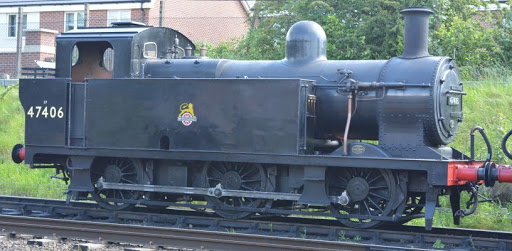
The Tri-ang 3F tank locomotive, “Jinty” was produced from 1952 until the mid 70’s. The version shown in the featured image was made between 1957 and 1959. It has the early BR crest and is lined. It has the early hook and bar coupling.

From the British Model Trains Catalogue, 2002 edition

Originally the model had an unlined black livery with British Railways spelled out in words.

The earliest version of the Triang Jinty from 1952

The prototype

The origins of the 3F Jinty locomotive date back to 1899. They were built to a design by Johnson of the Midland Railway. Later Fowler of the LMS modified the design and over 400 were built between 1924 and 1931. Various manufacturers built them including the Ex Lancashire and Yorkshire works at Horwich.

They were numbered by the LMS from 7260 to 7681. British Rail simply added a 4 prefix. the model has the number 47606. Withdrawals began by 1959 although some lasted until the end of steam.

They were also used for light passenger and short trip duties.

The model

The body is made out of moulded plastic, early versions being made of acetate. The whistle is also painted plastic. It is quite a hefty beast at 212 grams. Buffers are plastic with a painted buffer beam. The motor intrudes into the cab and there is a rather prominent screw in the chimney. Hand rails are moulded and not picked out. Also the number on the smoke-box door is present but should be picked out in white.

Photo by the author

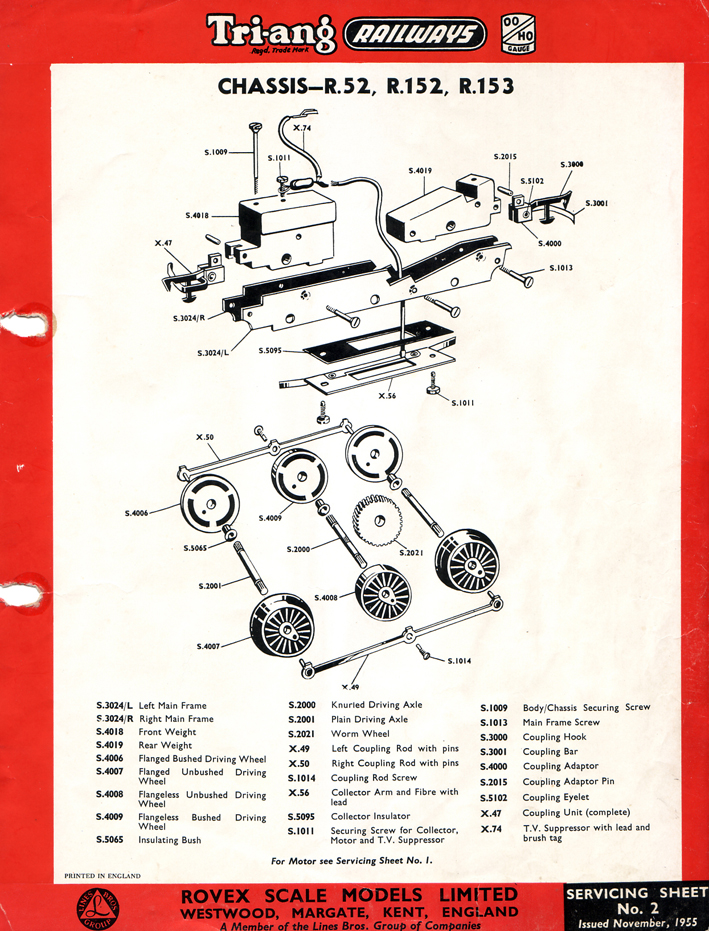
The chassis used is the R52 with phosphor bronze pickups and brass gears, this chassis went through various revisions. Many thousands of this model were made. They usually run well if kept oiled.

Photo by the author

The Jinty is seen here in the 1961 catalogue, as part of a train set. It has the later BR crest. Note, the shunter uses the same chassis.

Catalogue scan by the author
The RS.4 set with series 3 track. from Triang-man

Here we see a scan from the December 1961 edition of Model Railway Destructor. The price of the RS.4 set is approximately £5, which is £112 in today’s money. This was affordable to most families. Note the monthly terms for the less well off.

Model Railway Constructor Dec. 1961 – Scan by the author

As a bonus two early Rovex LMS coaches are shown. These were made in 1950 for the original Marks and Spencer train set. Only 6″ long, they are remarkably crude and toy like. However the bogies are made of metal, with plastic wheels. There is no interior seating. Oddly the buffers are also metal. The amount of play on the bogie pivots is enormous, this gives them a rather comical wobble in operation. They were available until 1956.

Photo the author
From the British Model Trains Catalogue, 2002 edition.

The R.52 on the Hornby Railways collectors guide

The Triang R157/8, DMU Class 101. Retro Review

The Class 101 DMU was in the Triang -Hornby range for a long time. It first appeared in 1958 and continued in various guises into the 1970’s. The main problem with the model is the inaccurate length. It should be a scale 57′, which is 228 mm, the actual length is 207 mm, the same as the Triang coaches of the time. The prototype was built to diagram B.R. 630 by Metro Cammel. The real vehicle was also long lived.

The prototype

The Class 101 units were built between 1956 and 1959 and were the longest serving of the first generation DMU’s. The last not being withdrawn until 2003. The original livery was green with yellow lining. The yellow warning panel was not added until the 1960’s. They were seen over much of the network, including the North West and Lake District.

Class 101 at Keswick in 1967.
Continue reading “The Triang R157/8, DMU Class 101. Retro Review”

The Warszawa 203 Polish automobile (223/224) -Mag Models 1/43 review.

Origins

The Warszawa was a Polish vehicle built from 1951 to 1973 by the FSO Passenger Automobile Factory in Warsaw. Originally based on the Opel Kapitan of 1938. The design similarities are apparent in the 1951 version.

They were popular due to their “bullet proof” design, capable of handling bad roads, bad fuel and heavy use, hence their popularity as taxis.

Now available is a 1/43 scale metal model of the Warszawa 203, that is accurate to the prototype.

Continue reading “The Warszawa 203 Polish automobile (223/224) -Mag Models 1/43 review.”

Accrington’s railways ” a monstrous aberration”

Accrington has had a railway since 1848. The station is now vastly smaller than at its peak in the 1930’s and direct services to Manchester did not resume until 2016.

The Current Station at Accrington Photo G Whittaker

Origins – the Manchester Bury and Rossendale Railway

After the success of The Liverpool and Manchester railway, in the 1830’s, another group of Manchester business men eyed the potential of a line from Manchester to Bury and beyond, up the Rossendale valley.

1848 and all that

R.W. Rush has described the original layout of Accrington station as a “monstrous aberration” in his book on the East Lancashire Railway. Only one platform was provided with the booking office across four tracks, on the opposite side! Trains were arranged to arrive simultaneously from three directions. This resulted in a circus of shunting and pulling to get the trains into the solitary platform.

Map from The East Lancashire Railway by R.W.Rush

The Stubbins to Accrington extension, 1845, Building commences

The contract for building the line from Stubbins to Accrington was awarded to John Brogden. It was difficult to build with huge gradients and boggy land at Baxenden summit.

The original East Lancashire Railway buildings survived into the 1970’s. The curved viaduct can be seen heading towards Burnley in this mid 1960’s image. The line to Manchester has been singled at this time. It closed completely in 1966.

The 1960’s closures

The line to Manchester closed in 1966.

Goods train on Accrington viaduct 1965

Yorkdale update #1 – The coal siding

The layout

Yorkdale is a 00 layout set in the 1960’s, it represents a fictional line that would have run from Grassington up Wharfedale to Hawes, in the Yorkshire dales. The line was proposed but never built. The baseboard is 6′ x 4′ with three ovals.

The coal sidding.

At the front of the layout there is a siding. The high ground on the right is made of 10mm polystyrene sheet covered in plaster bandage. It was then painted green using a match pot. The ground cover is Javis moorland mix scatter.

Track was ballasted using the technique here. Ballasting track – top tips. The track was first painted using humbrol dark earth enamel. The top of the rails were then wiped off.

The ballast bin buffer stop

The ballast bin buffer stop was made form a Wordsworth models download as was the hut. This is a cheap way to provide these useful items.

Backdrop

The backdrop is from ID backscenes. These are high quality and good value. Read about the best backscenes here. The road is just painted on to the baseboard . Vehicles are from the Oxford range.