The Dapol class 121 -review

The prototype

The class 121 Bubble cars were built from 1960 by the pressed steel company of Oxford. They were double ended with a cab at each end. A class 121 was still in use in 2017, on a heritage line. They had a top speed of 70 mph and were used mainly on the Western Region. Lightly used lines in Cornwall being their main area of operation.

The class 122 was similar although built by Gloucester RC&W in 1958. They also made a further nine single ended trailers.

The model – £99 approx.

The amount of detail for the price is amazing. The masking is crisp and the under frame painting adds a lot of visual appeal.

The height of the floor is a compromise and adding a few passengers would help to disguise this. Separately fitted detail includes windscreen wipers and handrails. The glazing is flush and has printed details. Door handles are picked out in silver.

Running

Certain versions of this model had problems with the bogies catching on the chassis detail, causing derailments. The version tested here did not have this problem. In fact it ran OK on first radius curves!

The gearing is low so that in runs slowly, even at half speed on the controller. The model does speed up once the lubrication warms up.

The model is Named Thunderbird 1

Thunderbird 1

Lighting

As a consequence of the low gearing the lights ,on DC, are rather bright even at medium speed. The cab ,carriage, head and tail lights can be switched off by internal switches. They are on by default, on the DC version. All the light can be controlled individually on DCC.

Conclusion

The model is great value and runs well once it warms up. It ran using an ancient Triang controller with no problem.

Terraced shop “In The Greenwood”, kit build and review

The kit

In the Greenwood produce a range of good value, laser cut kits. The shop reviewed here was £6.00 with free shipping.

On opening the nicely presented box, you get the unmistakable waft of burning wood! There are some rather thick plywood parts and a sheet of instructions. No glazing is provided. The chimney parts are bagged separately.

The build

The parts slot together well and are a good fit. I had an issue with warpage on the side walls. A block of balsa glued to the inside fixed this. Press the parts under a heavy weight until the glue has set. The build progressed quickly with the shell being completed in about 20 minutes.

After assembly give the model a coat of primer. This takes paint much better than bare wood.

Painting

Paint the bricks with a salmon red colour. Try to paint the surface only. The gray primer then looks like old mortar. The woodwork was painted green. The signage and interior are from the Scalescenes high street shops download. Glazing was made from some Javis thick clear sheet. The curtains are just an off cut of purple card. Some weathering was added to the roof.

To add depth use some thin card to make the window lintels.

Conclusion

This range is great value for money, the only caveat is the warpage problem and the thickness of the wood parts. The roof ,wall thickness and barge-boards are over-scale to a large degree. It would be fairly easy to replace the roof. This would probably be a good idea anyway, if you are making a row.

A thin shim of brick detailing for the front of the chimneys would also be a good idea. Finally, adding some glazing material would be helpful for beginners.

You can buy this model built to order.

Hornby J36, British Rail – Review.

The prototype.

Of the more than 20,000 locomotives in use at the turn of the 20th century, over one third were tender 0-6-0 types. In Scotland , the NBR decided to replace a number of older 0-6-0 locomotives. The J36 was known as the C class and was introduced in 1888. They were very successful locomotives, with over 100 being built by 1900. From 1913 the engines began to be rebuilt. A number served in France during WW I and were consequently renamed with tribute names.

The J36 was mostly used in Scotland for goods and passenger duties. They could also be seen in North Yorkshire. 123 locomotives continued into British Rail Service. Two were still in use in 1967, with only one being preserved.

The model

All images, the author. The model is available in a number of liveries. LNER, two original North British liveries and an early British Rail colour scheme.

In March 2019 “Maude” was released with TTS sound. This has a more elaborate North British livery. It is only available with TTS.

The model we look at here is the DC version of “Haig”, R3622 . It is available for £99, at the time of writing.

The J36 is quite a heavy model with a good flat black paint application. The boiler and firebox are made of die-cast metal as are other components. There is no boiler banding, only the running number and name are printed. The front windows are glazed. The safety valves are made of metal, while the whistle is not. The running gear is blackened and the wheel axle ends are realistic.

All the locomotives have sprung buffers . The detail pack includes the brake rigging, vacuum pipes and the front coupling. There are some tiny separately fitted parts at the front of the boiler. The smoke box door has a separately fitted dart.

Cab detail

The Cab detail is nicely painted although the gauges are not marked.

The internal valve gear is picked out in red and the reversing lever is made of metal.

The tender is well detailed with sprung buffers and a pre-fitted NEM coupling.

The verdict and running.

The model is good value for money at around £99. It is a smooth runner and the amount of die-cast is a bonus. The DCC socket is in the tender. You will need to remove two screws to get access.

How to light model railway buildings

Lighting can add another dimension to models. It is not too difficult, however, It needs some pre-planning and there are a few issues.

Types of illumination, filament bulbs.

The oldest method is to use grain of rice or grain of wheat bulbs. Grain of rice bulbs are a tiny 2mm x 6.5mm. Grain of wheat bulbs are 3mm x 7mm . They are quite current hungry at 30ma and 50ma each respectively and run at 12V. The four bulbs used in the shops model take close to 100ma in total !

Grain of rice bulb

Filament bulbs give a warm yellowish light which simulates gas lighting, if used on a lower voltage. The main problem is reliability and inaccessibility. If one blows they can be impossible to replace in some cases.

LED lighting

LEDs are much more reliable and use less power. White LEDs can be a bit harsh giving a much whiter light than filament bulbs. There are now many sizes from miniscule “chips”, to over 10mm in diameter. The most common size for model buildings is 3mm. You can use yellow LEDs to simulate gas lighting.

The voltage required for LEDs varies depending on the colour. You will need to use a resistor to run them on 12 volts. The voltage needed for full brightness is usually referred to as Forward Voltage or Vf. The current is usually set at 20ma. The table below gives an approximate guide. you can increase the resistance to reduce the brightness.

ColourVfResistor required for 12v supply at 20ma( full brightnes)
White 3mm3.3470R
Yellow 3mm1.8570R
Yellow Green 3mm1.8570R
Red 3mm1.8570R
Full green 3mm3.3470R

Light blocking

Card buildings are the easiest to light as the card tends to block light. However plastic kits need more attention. Paint the insides of the walls black. You may need to make a light box around shop windows, out of styrene. this will stop any light bleeds. Use filler to address any gaps and test with your choice of lighting, before sealing the building up!

Wiring it up

Filament bulbs usually come pre-wired . These can be threaded through a hole in the building’s base card. You can get LED’s that are pre-wired for 12v. I usually use a dab of UHU to hold them in place, or you can use hot clue.

Make up a power “bus” under the model using doll’s house self adhesive copper strips. Solder the wires from each bulb to the bus bar and then Add the wires that will go to the PSU. If you are using LED’s use red and black wires so you maintain the correct polarity as LED’s only work one way round, Unlike filament bulbs.

Powering the lights

The 12v accessory output on model railway controllers can be used. You can also use the 16v AC output with a resistor for 12v bulbs. LEDs can be used on AC by wiring another diode across the LED and adding a resistor of about 1K, for white LEDs. This gives full wave rectification, experiment with the resistor value.

Old 12v DC controllers can be used to give variable brightness.

An example circuit is shown below using two LEDs, with one reversed. This is for 8V AC, hence the 560R resistor,

Railway photography – how to get the best shots

Manual shooting and exposure.

If you have a camera with manual exposure. shoot with the background slightly over exposed, as most engines tend to be black or green. This will make the loco less dark.

Modern clutter

Try to avoid any modern clutter, to keep that period charm. The only thing not period in the shot below is the black plastic bin bag. You can use good photo editing software to remove such anachronisms.

Shoot stationary trains for detail shots

For detail shots wait till the train is stationary and get as close as possible.

Shoot people

Having the driver in a shot adds interest and character. Drivers usually wear overalls and, if you are lucky a “period ” cap!

Shoot in winter

The East Lancs line, was shot below ,on a very cold January day. This made the steam much more obvious . The misty conditions were very period. This could be the 1950’s !

Shoot 3/4 shots

I usually shoot 3/4 shots that is with the loco 3/4 of the way around.

Use a zoom lens

A good zoom lens will bring the action to you. Try to avoid digital zoom, this will just drop the resolution. For flower beds and trolleys, crouch down so that you can get more distant buildings in the shot. This will also add drama.

Research locations

Most lines have a guide to the best photography locations, check out the relevant web sites.

Make sure you have a timetable and find out which way the engine will be facing. On the Ribble steam railway the engine will be going backwards on the way out. This line does not have many good vantage points. One of the best is the level crossing close to the station and docks.

Make a ruined farmhouse scene in “00”.

Javis make a range of ruined house pieces for wargamers . These are meant for 28mm or 1/56 scale . However, the scale discrepancy is not very noticeable with buildings. They are made of cast resin and need painting.

First give the casting a coat of grey primer. This will help to “key” the next coat of paint.

Stonework

Select a stone colour and paint the stonework. All paints used were Humbrol enamels. Next, with a mortar colour, paint the remaining rendering on the outside walls. The inside walls had the surviving plaster painted green. Dark earth was used for the floor of the ruin.

Detail painting

There is quite a lot of moulded detail on the casting. Wood splinters and an old door were highlighted with colour. The inside of the fireplace was painted red to simulate old brick.

The base

The base was cut from a piece of 2 mm card. Javis foliage material was used to disguise the edge of the casting. Finally Javis scatter was used for the grass.

Detailing

To add interest some Knightwing barells and crates were added. the tyres are spares from a kit.

This was a fun project using a bit of lateral thinking.

Buy this diorama now on eBay.

Building the Dapol Scammell Scarab lorry

The Dapol scammell, plastic kit is cheap and easily obtainable. The model builds into a nice vehicle for dioramas and station scenes set in the 1950’s and 60’s. It is based on the ex Kitmaster, ex Airfix kit and dates from the 1960’s so there is quite a lot of flash to deal with. There are some fiddly and minuscule parts to fit so you need a good magnifier and steady hands. The carpet monster ate the exhaust during the build!

The artwork mimics the original Kitmaster models

This kit comes with two trailer options but no windscreen. I used some thin transparent material to make one. You need to assemble the cab, deal with any seam lines and paint the cab,first. The colours for BR were cream and maroon. Railmatch can provide these colours, 2306 maroon and 2312 cream.

Continue reading “Building the Dapol Scammell Scarab lorry”

Bromley Cross photo set

Bromley Cross in on the Blackburn to Manchester line. The line passes through Entwistle which has a request stop. It then goes through Bromley Cross, Bolton and Salford to Manchester Victoria. Beyond Blackburn the line continues to Clitheroe. There is a service from Manchester to Clitheroe, through Blackburn.

Continue reading “Bromley Cross photo set”

The Building of Yorkdale Part 1, Initial design

How cheaply can you build a model railway?

Building a model railway can be an expensive business so how do you get a good start for minimal money? I have chosen to build a traditional; 6′ by 4′ layout on a pre-made baseboard. This gives scope to run a few trains and there is some operational potential.

Subscribe to my YouTube channel, Not Just Trains.

Track design

The design is a variation of Hornby track plan 5D, with the sidings moved to the inside of the loop. There is a factory siding on the right. this will add interest.

Control Panel

I have also gone the DC route, again for cost reasons. The control panel will be housed in a commercial slope front project case. Points are controlled by Hornby passing contact point levers. The only electric points used are those that cannot be reached from the front of the layout. I am using cab control with two controllers and, on – off – on, toggle switches to control each section.

Baseboards

First of all you need a good solid base to build on. Don’t skimp on the baseboard. This was obtained from Model Scenery Supplies for £185 shipped. There is a long waiting time of 10 weeks, but they are well made and save a lot of hassle. The board comes in two halves and has a plywood top.

Period and Location

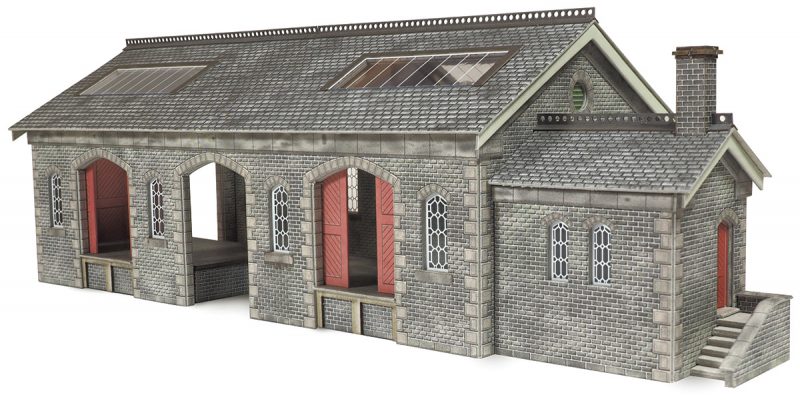
The location is the Yorkshire Dales, I have always wanted to use the Metcalfe Settle and Carlisle buildings! The era is now. The outside loop is a heritage line that has a link to the main line. This allows for steam charters to come off the heritage line.

PO336, 00 scale, Settle & Carlisle Goods Shed

Track

Track is a mixture of Hornby and Peco code 100. most of it is second hand.

Controllers

For now, I am using a couple of Hornby train set controllers.

Whats next?

Part two will be on fitting Peco point motors and wiring. I will also make some videos of progress on the layout.

I was looking for something to make soldering easier and found this on Amazon. This is great value and very useful if your eyesight is not as good as it used to be!

Follow this series on Twitter and Facebook.

What is the best glue for card Kits?

An often asked question is what type of glue do you use for Metcalfe and other card kits. I build kits commercially and have tried most types of glue. Probably the worst is standard PVA it takes forever to dry and causes warping.

There are two types of UHU glue one has a petroleum based solvent and the other is water based. The water based one also takes a long time to dry. I used The petroleum based solvent version of UHU for a long time. It sets fast and dries transparent. The biggest problem with UHU is stringing.

More recently I switched to Rocket card glue this sets fast and does not string. However it is expensive at £9.99 for 50ml. Javis make Velo-set PVA this is similar to Rocket glue, but you get more than twice as much for the same price! I now use the Javis product. No stringing and cheaper than Rocket.

Buy Javis Velo – set glue here.