Every layout needs a backscene . Here I look at what is available commercially. Additionally, what is the cheapest way to make a simple sky backscene?
Most 00 backscenes are around 12″ or 30cm high. Commercially produced backscenes range from 9″ to 25″ high .
Make your own backscene
You can make your own sky backscenes with blue card (mountboard). This can be obtained in A1 sheets, from Pullingers art supplies. A1 is is about 33″ x 23″. To get the blue colours, you need to order 10, at a total of £33.50 plus £4 for delivery. Delft blue or horizon blue make good sky colours. The Pullingers mountboard is about 1.4mm thick.
Another possibility is sky wallpaper. You will also need a thin ply backdrop to attach the paper to. The wallpaper is available from Wallpaper Direct.
Faller backscenes
Faller backscenes are available in the UK, from Gaugemaster. They are not cheap, but the ones that are mostly sky can be used on British outline layouts. They are quite deep at 25″ high, so you get a lot of sky for £35.
Faller backscene 3880 x 650mm
Gaugemaster backscenes
Gaugemaster have their own range of backscenes. The are about 12″ high and 9′ long. They are probably the best value here at £8.50 per sheet. The paper is a bit thin but there is a good range of UK scenes.
Gaugemaster sky sheets
Peco Backscenes
The old favourite Peco backscenes (available from Gaugemaster) are still in production. They are quite small at 28″ x 9″ and tend to look a bit cartoon like. However there are some useful sky papers that can be used for dioramas and photography backdrops. They are cheap at only £1.55 each.
Peco MountainsPeco sky paper
ID backscenes
Perhaps the creme de la creme of backscenes. ID backscenes are printed on heavyweight 180gsm paper . You get 10′ overall, in two 5′ rolls.
Printed with UV resistant ink, they will not fade or discolour. They come in two heights 9″ and 15″. The photography is of very high quality.
ID Backscenes
The video below takes a comprehensive look at fitting ID backscenes to a layout.
Metcalfe kits are seen in most model shops and are well made, so what do you need to build them successfully?
Building Metcalfe kits – This is how I build Metcalfe kits for our kit build service. The methods may differ from the instructions! I have built some kits 20 or 30 times so I know the quickest and easiest way to avoid the pitfalls!
Metcalfe Kits – Use a cutting mat and heavy knife.
You may be wondering why you need a knife with a die-cut kit. Metcalfe kits keep the parts in place by leaving uncut areas that have to be cut to release the part. A good heavy knife will give neater results than something thin and light , like a scalpel.
Updated , 13/4/22. Looking for Free model railway kits? Most download companies offer free kits as samplers. Other ranges are entirely free.
So who has the biggest range of kit downloads?
Wordsworth models has a large range of free downloadable kits. The later kits are more advanced. For example, some have transparent glazing. They can be made from 1mm and 2mm card or cereal packets.
They also have some useful texture sheets.
A fire station based on the Wordsworth Download, with a different finish
3DK free brick hut
3DK are a Canadian company. They produce a lot of British Outline kits that can be downloaded. There is a free brick officedownload that has a lot of detail and a good range of signage. The windows can be printed onto a clear sheet.
The other buildings in the range are good value at less than £4.
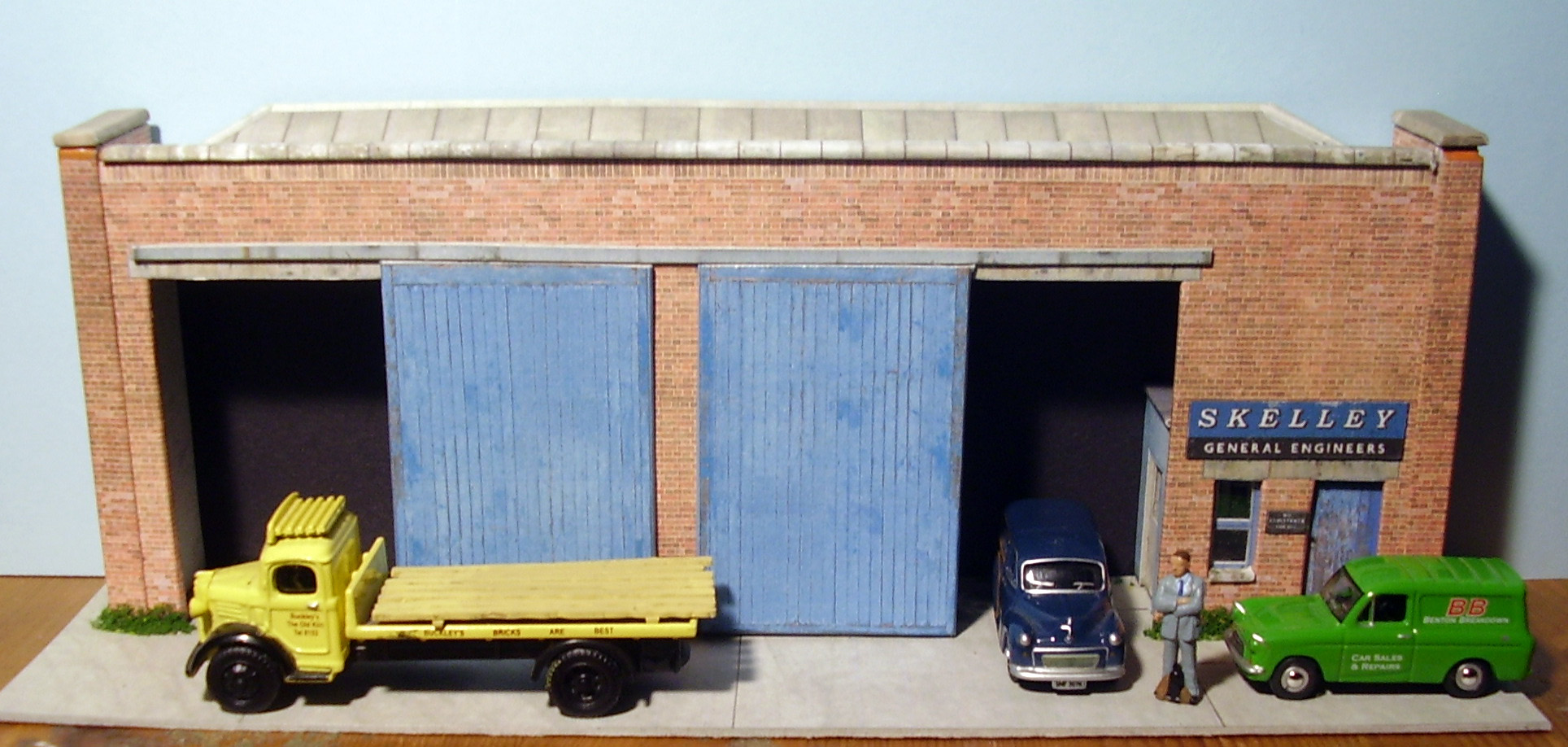
Buildings don’t just exist in isolation, they have a context. Grass tends to grow up along the bottom of walls.
All photos, G Whittaker.
There are often road markings and other clues as to the function of a building. Below I added some grass to the edge of the building, this will also hide any gaps! The playground markings make it obvious that this is a school.
School building made of card.
Model the environment by adding textures. The yard below is made of sand ballast. The walls are 4mm balsa wood and the chimney is made of thicker balsa wood. Add a few cows and you have a farm yard scene. Most of this building is made of cereal packets.
A yard made of sandy ballast.
Street furniture and vehicles
Cars and people help to blend buildings into a scene. Below, add a few cars and you are in the 1960’s .
Walls are everywhere from the humble dry stone wall to massive embankments and bridges. What are the best products and techniques for making walls for your layout? This article looks at Model Railway Walling and Fencing.
Card and Balsa wood walls – case study
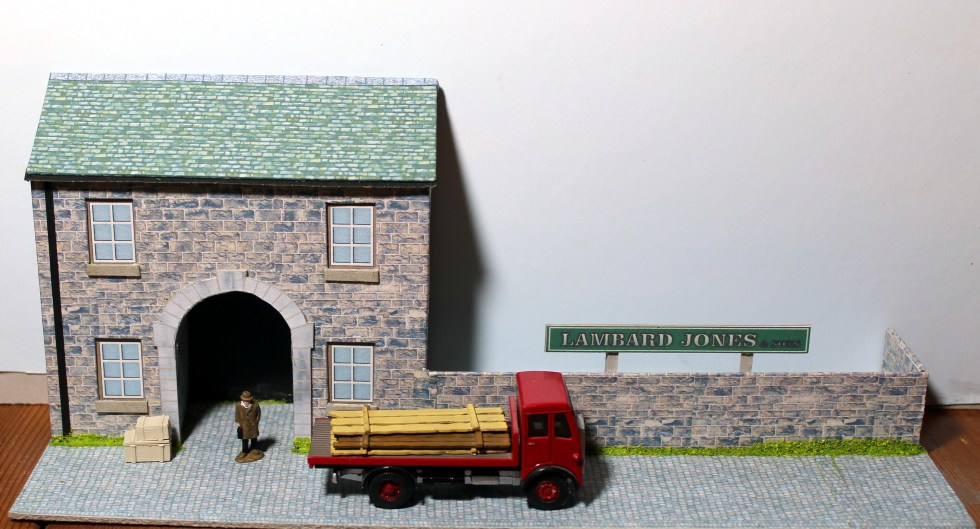
The factory entrance below was made from a Wordsworth Models download and some 2mm card. The stone texture was made from my own photograph and edited in Photoshop. The type of card I use is 2mm and 1mm grayboard This is available cheaply from Ebay and Amazon sellers. You don’t need to use the more expensive whiteboard, although the grain is finer.
For thicker walls 4mm balsa wood is easy to work with and works well. The base for the entrance is 2mm grayboard With Wordsworth’s cobbles texture sheet on top. You can also make top stones for the wall, from another strip of card. The sign is made from strips of card glued to the back of the wall.
Grayboard card
Next I take a look at the different materials that are used to make walls and fences for model railways and dioramas.
Farm walls and fences for model layouts
Farm Walls and fences are available in an amazing number of different materials. In order of expense, we have
Home made from card and matchsticks
Granite chips on a foam base( flexible walling)
Printed embossed card
Injection moulded plastic
laser cut card
Cast resin
Etched brass
I will look at each in turn
Home made fencing for model railway layouts
The cheapest option for railed fencing is matchsticks, you can also use 2mm card strips. Cut some 2mm grayboard into 2mm strips with a sharp bladed knife, these are the longitudinal fence rails. You don’t need to be super accurate. Cut out another piece of card about matchstick length and then cut this into smaller 2mm strips for the uprights. Card is much easier to cut than matchsticks.
Card strip fencing
Lay the three longer strips out on a modelling board and dab some PVA on each rail at appropriate intervals. Place the uprights in place. PVA takes a while to set giving you time to adjust the positioning. Grayboard is almost the correct colour or it can be painted easily. gates can be made in the same way.
For the post and wire type of fencing, some use nylon thread for the wires, but I find florist’s wire easier to work with. Use 26 gauge wire, or as near as you can get to 0.5mm wire. Drill 0.5mm holes about 4mm apart in the posts. Drill holes for the posts in the baseboard and then fit the wires.
Model Railway Walling and Fencing – Flexible walling and hedging
Javis make a range of flexible foam walling . This is not very realistic but can be used in the background. The advantage is, It is quick and easy to work with. You can use N gauge walling on a 00 layout, for forced perspective, to make it look further away.
Arch make a range of flexible laser cut dry stone walling. This fits to any contour, but is relatively expensive at around £9 for seven pieces. However, The detail is lovely and it is probably the most realistic available.
Printed card for model railway walls and buildings
Metcalfe do a range of non embossed card for scratch building. This is available in brick and stone as well as cobbles and pavements. It is good value and handy if you have other Metcalfe buildings on your layout.
Embosed plastic sheet is also available from plasticard. This is fairly easy to cut by scoring and snapping. Wills do a range of plastic sheets that are injection moulded. They are thick and not as easy to work with as Plasticard.
Finally ID Backscenes make a range of self adhesive papers that are nicely done. At more £1 for an A4 sheet they are not cheap, but look amazing.
Javis of Stockport make the biggest range of resin walling and fencing. There are many types of wall as well as corner pieces. Some are flocked. One caveat is that some of the fences are single sided only, they are best used where there are no right angled corners.
They are quite heavy and good value at less than £2 each.
Etched brass fencing for model railways
At the top end of the market are etched brass fences and railings. These were made by Scalelink (langley) . They have a truly terrible web site. Recently the brass fret business has been split off and is now trading as Scalelink Fretcetera. They have a slightly less terrible web site!
Most of the fence sheets are £9. You get quite a big bang for your buck with up to seven railings per sheet. They have some fun figures as well as architectural items such as staircases.
This website uses cookies to improve your experience. We'll assume you're ok with this, but you can opt-out if you wish.AcceptRejectRead More
Privacy & Cookies Policy
Privacy Overview
This website uses cookies to improve your experience while you navigate through the website. Out of these, the cookies that are categorized as necessary are stored on your browser as they are essential for the working of basic functionalities of the website. We also use third-party cookies that help us analyze and understand how you use this website. These cookies will be stored in your browser only with your consent. You also have the option to opt-out of these cookies. But opting out of some of these cookies may affect your browsing experience.
Necessary cookies are absolutely essential for the website to function properly. This category only includes cookies that ensures basic functionalities and security features of the website. These cookies do not store any personal information.
Any cookies that may not be particularly necessary for the website to function and is used specifically to collect user personal data via analytics, ads, other embedded contents are termed as non-necessary cookies. It is mandatory to procure user consent prior to running these cookies on your website.